Spanish Version - Romanian VersionNGC Catalog - Main Galery
Spanish Version - Romanian VersionNGC Catalog - Main Galery
(Clic to higher resolution) |
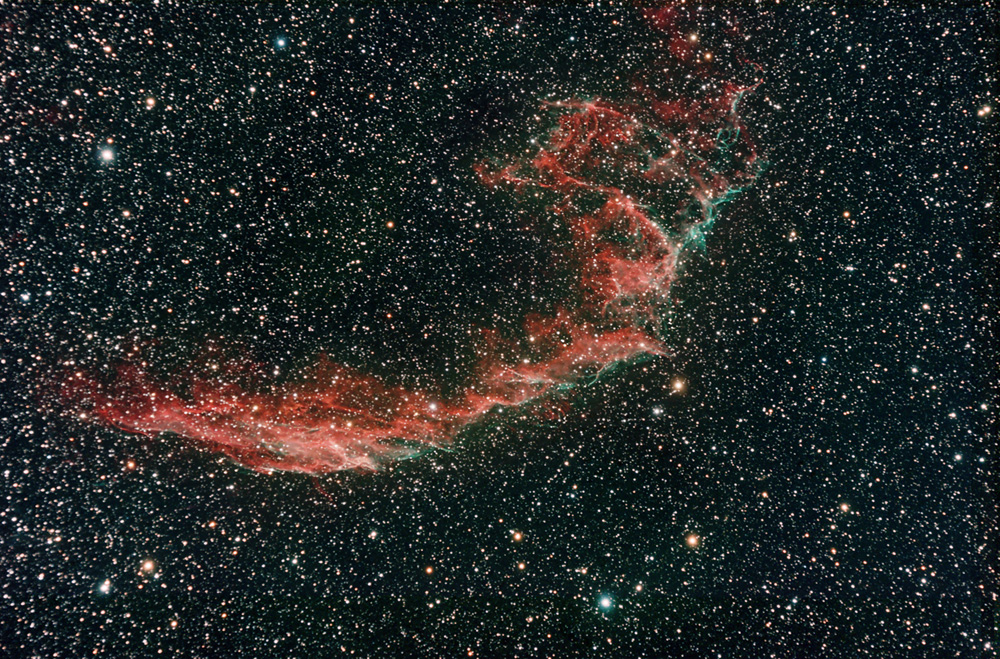
Previous image RGB, 2007
|
© by manuel fernández 2005/2013 - www.elfirmamento.com |
| LOCATE | INFRARED OBSERVATORY, LEON (SPAIN). 2012- 2013 |
| TELESCOPE | TAKAHASHI TOA 130 APO+REDUCER @ f/5,6 (760 mm) |
| MOUNT | TAKAHASHI EM400 TEMMA 2 |
| CAMERA | CCD QHY9 @-20º |
| GUIDE | SBIG STV CAMERA + EZGUIDER 60mm. |
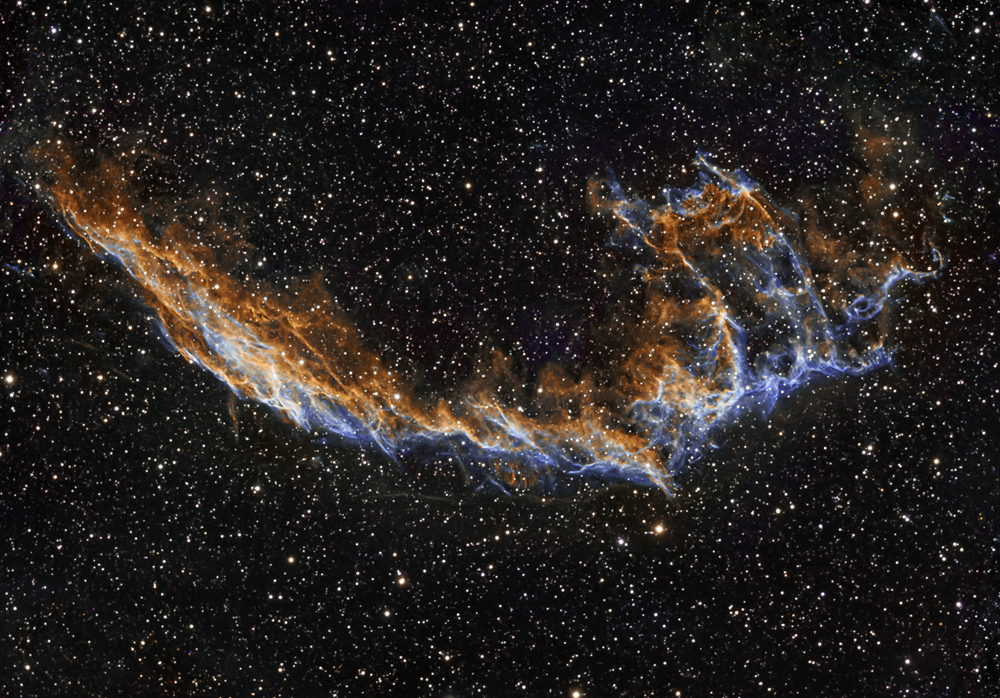
| EXPOSURE | Ha 15x30 min, OIII 15x30 min, SII 14x30 min. TOTAL 22 HOURS |
| FILTERS | IDAS LPS, Ha Astronomik 6nm, OIII Baader, SII Baader |
| PROCESS | MAXIM, PHOTOSHOP, NOISEWARE, HLVG, Astronomy Tools, Annie's Astro. |
| CALIBRATION | FLATS, DARKS, BIAS |
| NOTES | Narrowband image in SHO (Hubble Palette). |
| REFERENCES | http://en.wikipedia.org/wiki/Supernova |
Nebulae call "Veil" is the remanent of a supernova that exploded about 8,000 years ago in the constellation Cygnus. The eastern veil is located about 1,400 light year form Earth and its visual magnitude is 7. A supernova is a stellar explosion. Supernovae are extremely luminous and cause a burst of radiation that often briefly outshines an entire galaxy. Supernovae can be triggered in one of two ways: by the sudden reignition of nuclear fusion in a degenerate star; or by the collapse of the core of a massive star.